
The eruption of baby teeth is an inevitable part of a child's growth journey. However, during this process, many observant parents notice: "Hmm? Why does my baby's tooth look so strange? Is it serious? Does it need medical intervention?"
Indeed, in my daily clinical practice, I've seen all kinds of "adorable yet bizarre" baby teeth. Among them, some are normal phenomena that require no intervention, while others need careful monitoring and timely medical attention.
So how can we ease unnecessary anxiety while not delaying timely intervention for problematic teeth? Follow along as I explain below.
Strange Shapes
Looks Like a Tooth but Isn't
In newborn babies, you can often see small pearl-like white spots in the oral cavity. They feel hard like teeth when touched, but don't quite look like regular teeth. These are commonly called "horse teeth" (马牙), with the medical term being "Epstein pearls" (上皮珠). They are remnants of epithelial tissue left over during tooth development, and will gradually disappear over time. Generally, no special treatment is needed.
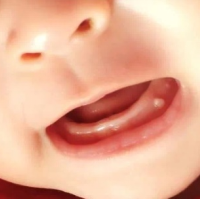
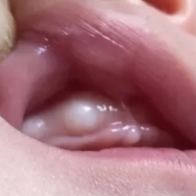
When cleaning your baby's mouth, parents can check whether the white spots are loose. If there is a possibility of loosening and falling off, it is recommended to visit a dentist for evaluation.
Small Serrations on Teeth — Too Many Sunflower Seeds in a Past Life?
Some netizens have shared photos of their baby's newly erupted teeth with two notches on them. Was this from cracking too many sunflower seeds in a past life?
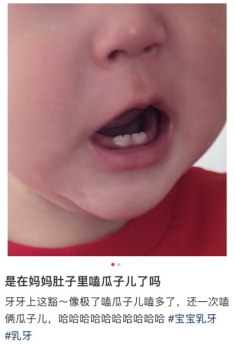
Haha, of course not. There are two situations for serrated teeth:
1. Fused Teeth
More commonly seen in deciduous anterior teeth, this is a relatively common dental developmental anomaly. It occurs when two teeth fuse together during development. After eruption, you can see a gap between the two teeth, looking like a small notch.
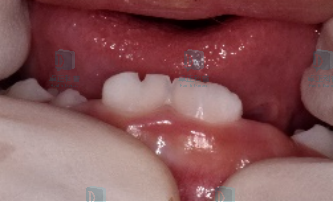
Besides the serrated type, fused teeth can come in various other shapes, such as butterfly-shaped or hill-shaped.
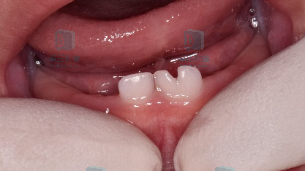
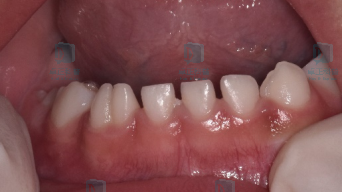
If you discover this condition in your child, there's no need to worry too much. Just make sure to keep the notch area clean. For deeper fusion seams, pit and fissure sealant can be applied to prevent cavities.
About half of fused teeth may be accompanied by absence of the underlying successor permanent tooth germ. You can wait until the child is older to take an X-ray for further evaluation.
2. Mamelons
Newly replaced front teeth (permanent teeth) all have serrated structures at their edges. This is not a developmental abnormality, but rather a unique structure of young front teeth — a hallmark of being "brand new" — called "mamelons" (生长叶).
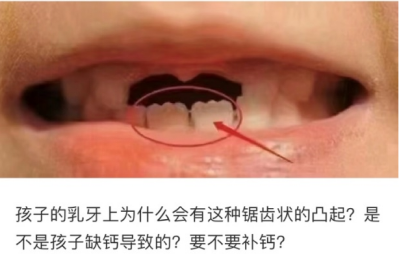
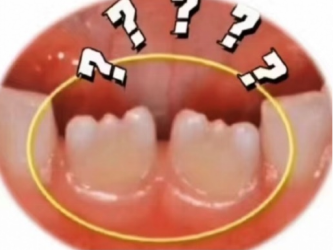
Why don't adult front teeth have serrated structures and look smooth? That's because as we age, the serrated structures on teeth get worn down. Therefore, having these small serrations on newly replaced front teeth is a normal phenomenon and requires no treatment.
"E-Type" Teeth: Growing an Extra Cusp
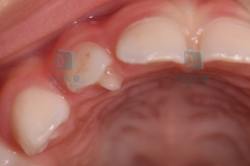
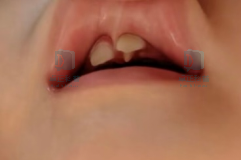
Some teeth have a rather "extroverted" personality. Due to being too flamboyant during development, they end up with one extra cusp compared to normal teeth. For front teeth, the most common is the talon cusp (畸形舌侧尖); for back teeth, it's the dens evaginatus (畸形中央尖).
1. Talon Cusp (畸形舌尖)
More commonly seen on deciduous or permanent front teeth, presenting as a "T"-shaped tooth morphology. If a talon cusp is discovered, it is recommended to have a dentist evaluate whether it interferes with the bite. If it interferes with occlusion or the cusp fractures, it needs to be treated by a dentist.
2. Dens Evaginatus (畸形中央尖)
More commonly seen on premolars that replace around age 9-10, presenting as a tall, protruding cusp in the center of the tooth. This cusp is often very thin and tall, easily fractures, and can cause pulp infection. Therefore, it is recommended to perform grinding adjustment or reinforcement as soon as the tooth erupts.
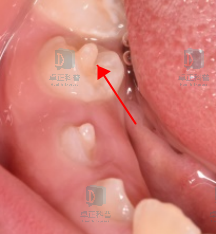
Since it is difficult for parents to detect and judge this abnormality on their own, regular dental check-ups are extremely important.
"I-Type" Teeth: Dens Invaginatus (畸形舌侧窝)
Some teeth have a rather "introverted" personality. During development, the enamel invaginates inward, forming a "dens invaginatus" (畸形舌侧窝), commonly found on the inner side of newly replaced upper front teeth.
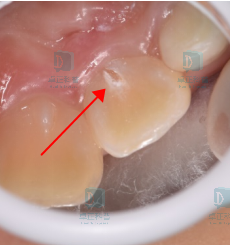
Note: Dens invaginatus is located in a hidden position and easily harbors food debris, leading to cavities or even pulp infection. Therefore, it is recommended to detect it early and apply pit and fissure sealant for prevention as soon as possible.
Strange Numbers
An Extra Tooth Popping Up on the Palate?
Around the age of tooth replacement, some children suddenly discover an extra tooth growing on their palate — pointy and scratching the tongue, quite alarming. Upon examination, it turns out to be a supernumerary tooth (多生牙).
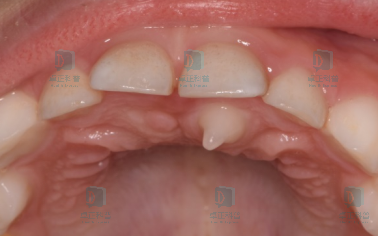
Supernumerary teeth, as the name suggests, are extra teeth that have grown beyond the normal count. Clinically, supernumerary teeth are not uncommon — a few out of every 100 children have them.
Supernumerary teeth that can erupt are actually the lucky ones. In fact, a considerable number of supernumerary teeth hide silently within the jawbone. They can be oriented in various directions and may potentially affect the normal eruption of neighboring teeth. Therefore, they need to be taken seriously and monitored.
Since they're buried in bone and invisible, how can we detect them early?
You guessed it — X-rays! It is generally recommended to take a panoramic dental X-ray when the child starts losing teeth around age 6, to screen for tooth number, arrangement, and developmental status.
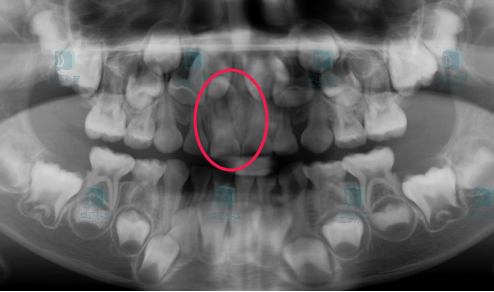
Impacted inverted supernumerary tooth
Sparse Gaps Between Teeth — Turns Out Some Teeth Are Missing
Some children have large gaps between their teeth because they have an insufficient number of teeth — that is, congenitally missing teeth (先天缺牙). Congenital tooth absence has a genetic tendency, and in rare cases is related to systemic diseases.
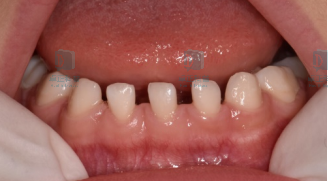
Congenital absence of deciduous teeth generally does not require intervention. If congenital absence of permanent teeth affects chewing or aesthetics, it is recommended to seek examination and decide on treatment based on the specific situation.
However, not all children with sparse tooth gaps have missing teeth. For example, most deciduous dentitions have some scattered gaps between teeth — this is a normal phenomenon, and parents need not be too anxious.
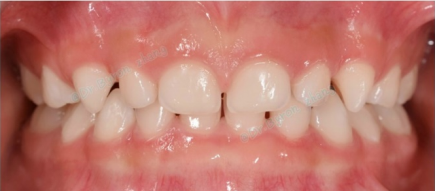
Healthy deciduous dentition with scattered physiological spacing
Strange Colors
Strange tooth colors can be divided into two situations: 1. Abnormal color of the tooth itself; 2. Color abnormalities caused by external factors.
Intrinsic Tooth Color Abnormalities
Common conditions include enamel hypoplasia, dentinogenesis imperfecta, and dental fluorosis.
1. Enamel Hypoplasia (牙釉质发育不全)
The etiology of enamel hypoplasia is not yet clear. It is currently considered a multifactorial disease, including systemic diseases, environmental factors, and epigenetic factors that cause enamel mineralization defects. Children with enamel hypoplasia should focus on caries prevention, have severely defective enamel restored with crowns, and undergo further dental restoration in adulthood based on the situation.
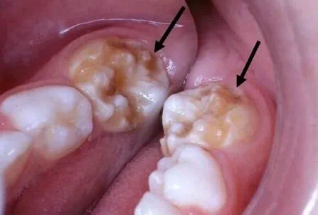
2. Dentinogenesis Imperfecta (牙本质发育不全)
Dentinogenesis imperfecta is a hereditary disease. Its typical presentation is teeth with an amber color, prone to widespread wear and enamel peeling, subsequently leading to pulp and periapical pathology. Therefore, early detection and early protection are crucial.
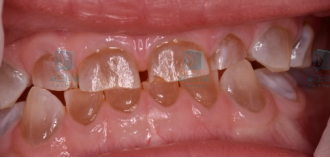
If you notice your child's teeth showing this amber-colored change, seek help from a professional pediatric dentist as soon as possible.
3. Dental Fluorosis (氟斑牙)
Dental fluorosis is generally caused by excessive fluoride intake before age 6-7, and is more common in populations from high-fluoride areas.
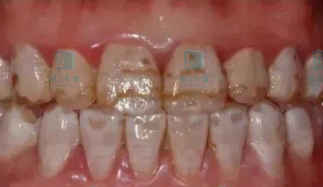
The main prevention and treatment measures are improving water sources and changing unhealthy dietary habits. Fluorosis in childhood generally does not require treatment; severely defective areas can be locally restored. Treatments to improve appearance can be performed in adulthood.
Extrinsic Color Abnormalities
For example, black staining, yellow staining, dental calculus, etc.
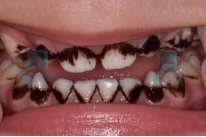
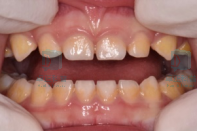
Left: black staining; Right: yellow staining
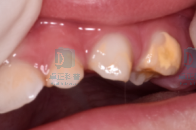
Dental calculus
These color abnormalities caused by external factors are not problems of the teeth themselves, and therefore can be removed. For example, children's tooth staining can be cleaned and polished by a dentist using special instruments.
Strange Alignments
V-Shaped Arrangement
When a child's newly erupted deciduous or permanent front teeth are arranged in a "V" shape (八字形), does it need intervention?
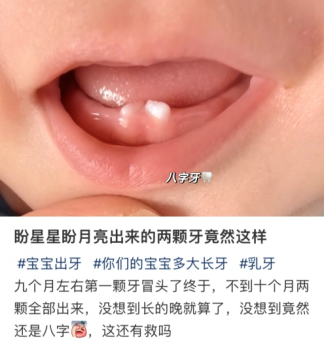
For V-shaped arrangement of deciduous front teeth, if the bite between upper and lower teeth is normal, intervention is generally not needed. At this stage, pay attention to whether the child has any bad oral habits (such as thumb-sucking, nail-biting, lying down while drinking milk, etc.). If present, these should be corrected, with regular follow-up visits. A V-shaped arrangement of deciduous teeth does not necessarily mean the permanent teeth will also be V-shaped.
If the teeth are still V-shaped after replacement, orthodontic evaluation is recommended around age 7. Generally, a simple V-shaped arrangement does not require immediate intervention and can be adjusted after all teeth have been replaced. However, if combined with narrow dental arch or occlusal interference, early intervention may be needed.
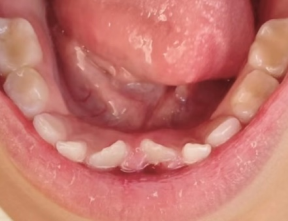
Double Row Arrangement
Nowadays, many children develop "double row teeth" during tooth replacement: new teeth and old teeth line up in two rows, appearing simultaneously in the mouth.
This condition is called retained deciduous teeth (乳牙滞留), commonly known as "double row teeth" (双排牙). Simply put, the old deciduous tooth hasn't had time to fall out before the new permanent tooth has already eagerly grown in.
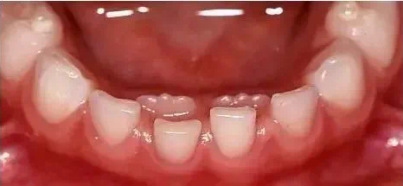
If your child develops double row teeth, it is recommended to take them to visit a dentist to see whether the retained deciduous tooth needs to be extracted early.
Alright, that concludes our review of the commonly seen strange and unusual teeth in clinical practice. What other strange teeth have you encountered? Feel free to share in the comments.
Zhao Hechuan
Distinct Pediatric Dentist
Disclaimer & Credits
This article was initially drafted with AI assistance, refined by our editorial team, and finalised following professional review by Distinct Healthcare physicians.
This is original content by Distinct Healthcare, provided for informational purposes only and not intended as medical advice. For personalised guidance, please consult a qualified physician.
Contact: health_content@distincthealth.com
Produced by: Distinct Healthcare · Health Express Team
Editorial: Health Express Editorial Team
Medical Review: Distinct Healthcare Physician Team