
Your child joins a sports class, and after running or jumping, always has to squat down gasping for air. Even after resting for a long time, their chest still feels tight. After this happens repeatedly, many parents can't help but worry: could this not just be from lack of exercise, but rather a sign of "asthma"? Let's analyze this together.
Which Type of "Wheezing" Is Just a Normal Exercise Response?
Under normal circumstances, as exercise intensity increases, a child's breathing will gradually deepen and quicken — this is the body's normal response to meet greater oxygen demands. This type of breathlessness is usually controllable, and after the child stops exercising and rests briefly, it typically improves noticeably within 1–5 minutes.
In most cases, it mainly presents as "panting" or "rapid breathing," but usually is not accompanied by obvious dry cough, repeated wheezing, throat itchiness, or persistent chest tightness. We call this "physiological breathlessness."
Physiological breathlessness is often related to exercise intensity and exercise habits. For example, suddenly increasing exercise volume or starting high-intensity exercise after a long period of inactivity can cause a child to noticeably pant after exercise. As exercise stops and the body gradually adapts, breathing usually returns to normal relatively quickly.
Which Type of "Wheezing" Requires Vigilance?
If the following situations occur, vigilance is indeed warranted:
- Obvious breathlessness occurs during exercise, or even shortly after starting exercise;
- Breathing feels tight, like "air can't get in";
- After stopping exercise, the child still cannot recover for a long time;
- Accompanied by coughing, chest tightness, or a "squeaky" wheezing sound during breathing, or wheezing occurs.
When a child develops these respiratory symptoms during exercise, multiple causes may be involved. Let's look at several of the more common causes one by one.
Exercise-Induced Bronchoconstriction
What parents worry about most is exercise-induced bronchoconstriction (EIB).
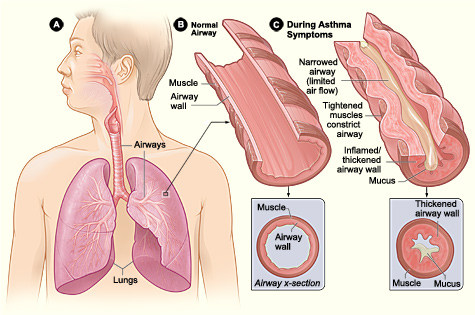
Left: Normal airway diameter is unobstructed, allowing air to flow freely in and out. Right: During an asthma attack, the airway wall thickens due to inflammation, surrounding muscles constrict, and more mucus is secreted, causing the airway to narrow and resulting in symptoms such as wheezing, chest tightness, and difficulty breathing.
EIB refers to an acute episode of bronchoconstriction that occurs during or several minutes after exercise (the latter being more common).
Patients typically develop bronchoconstriction during exercise or within 3 minutes after exercise ends, peaking at 10–15 minutes, and resolving within 60 minutes.
EIB has the following characteristics:
(1) Symptoms Tend to Occur During or After Physical Activity
The main characteristic of EIB is: breathing difficulty, coughing, and chest tightness that occur during or after physical activity.
Breathing difficulty: During exercise, patients may feel short of breath, unable to inhale deeply, or have difficulty exhaling. After exercise ends, patients may find that exhaling becomes difficult or prolonged.
Coughing: Frequent coughing during or after exercise, occasionally with sputum production.
Chest tightness: Patients may feel a tight or heavy sensation in the chest, similar to being pressed or squeezed.
Wheezing sounds: During an exercise-induced asthma attack, high-pitched breathing sounds or wheezing may accompany the episode.
(2) Symptoms Tend to Occur in Cold, Dry Conditions
This point also deserves attention. The occurrence of symptoms is likely related to inhaling large amounts of relatively cold, dry air during vigorous exercise. This may alter the osmotic pressure environment on the airway surface, thereby triggering bronchoconstriction.
Research has found that when the inhaled air is more humid and closer to body airway temperature, the degree of exercise-induced bronchoconstriction may be reduced.
(3) Symptoms Tend to Occur When Exposed to Allergens
Patients with allergic asthma who exercise while exposed to relevant allergens, such as pollen or mold, are more likely to develop EIB.
Note: Not everyone with airway hyperresponsiveness will develop exercise-induced bronchoconstriction (EIB). Currently, it is believed that the likelihood and severity of EIB are more closely related to the degree of airway hyperresponsiveness and the presence of airway inflammation. Among these, increased eosinophils in the airways are often considered a manifestation of airway inflammation.
In other words, some patients with mild intermittent asthma who have only mild airway hyperresponsiveness and relatively mild airway inflammation may not necessarily develop clinically significant bronchoconstriction symptoms even after vigorous exercise.
Exercise-Induced Laryngeal Obstruction (EILO)
Previously also called "vocal cord dysfunction," its hallmark is inspiratory stridor with respiratory distress during exercise — meaning the child experiences obvious breathing difficulty during "inhalation," with a sharp sound coming from the throat. It may also be described as "feeling like the throat is being squeezed."
It is important to note: EILO does not respond to inhaled corticosteroid therapy, nor does it respond to inhaled β₂-receptor agonists (such as salbutamol). The gold standard for diagnosing EILO is continuous laryngoscopy during exercise.
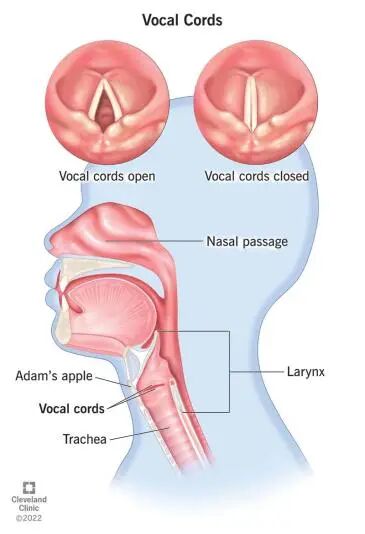
Exercise-Induced Laryngomalacia
Exercise-induced laryngomalacia commonly presents as inspiratory stridor during exercise — meaning the child produces an obviously sharp breathing sound when inhaling.
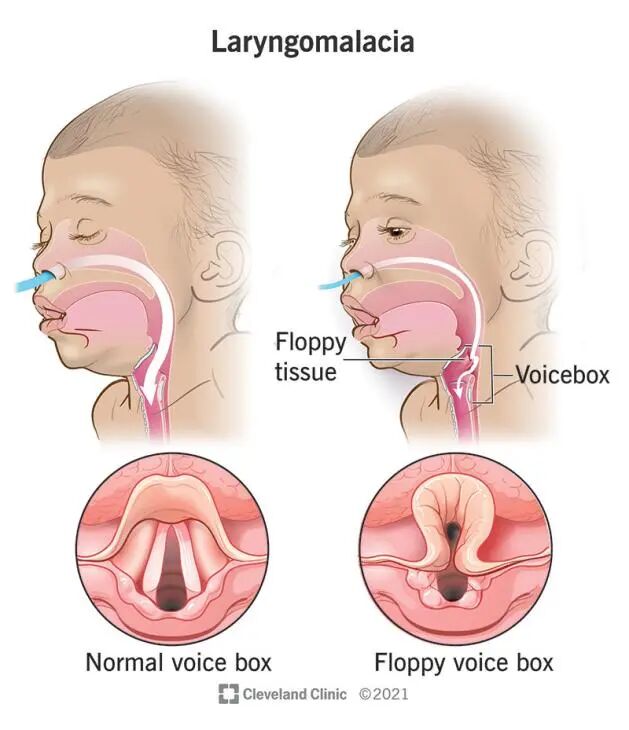
Left: Under normal conditions, air can pass smoothly through the larynx into the airway. Right: In laryngomalacia, some laryngeal tissue is relatively lax and may collapse inward during inhalation, causing the airway to narrow, resulting in a higher-pitched breathing sound and labored breathing during inhalation.
Currently, it is believed to be mainly related to abnormal collapse of certain laryngeal structures during exercise — for example, the aryepiglottic folds paradoxically moving inward toward the laryngeal cavity, partially obstructing the glottic area and thereby impeding air entry.
It is not the same condition as "tracheomalacia," and the site of pathology is also different.
This type of condition usually requires dynamic flexible laryngoscopy during exercise to more accurately establish the diagnosis.
Exercise-Induced Anaphylaxis
This refers to the child suddenly developing systemic allergic symptoms and signs during exercise. Before a full-blown episode, some "prodromal manifestations" may appear first, such as generalized itching, skin flushing, urticaria (hives), and marked fatigue.
In some cases, it may also be related to specific foods — meaning the child is more likely to have a reaction if they exercise after eating certain foods.
In severe cases, the child may develop laryngeal angioedema leading to breathing difficulty; however, relatively speaking, hypotension, syncope, and shock are more common presentations. (If a child has previously experienced a severe systemic allergic reaction during exercise, they should carry an epinephrine auto-injector or epinephrine nasal spray at all times.)
Exercise-Induced Laryngopharyngeal Reflux
Laryngopharyngeal reflux occurring during exercise may sometimes present with symptoms similar to exercise-induced bronchoconstriction (EIB) or mild exercise-induced allergic reactions, such as: facial flushing, throat discomfort, hoarseness, as well as chest tightness or coughing.
However, this type of condition usually does not present with obvious severe breathing difficulty, nor is it commonly accompanied by generalized itching, urticaria, or other typical allergic manifestations.
Breathing Dysfunction
Some breathing pattern or respiratory function abnormalities may also make it easier for children to experience persistent breathing difficulty during exercise. For example:
- Hyperventilation (breathing "too fast, too deep, too forcefully")
- Frequent "sigh-like" deep breaths
- Shallow, rapid breathing that primarily relies on chest wall movement
- Chronic mouth breathing
- Obvious use of accessory neck muscles even at rest
- Or incoordination between chest and abdominal breathing rhythms
All of the above situations can affect normal breathing efficiency, making it easier for children to feel "unable to catch their breath" during exercise.
Hyperventilation Syndrome
If a child develops shortness of breath, dizziness, and numbness or tingling in the hands, feet, or around the mouth when nervous, "hyperventilation syndrome" should be considered. This is caused by breathing too fast and too deeply, leading to a drop in carbon dioxide levels in the body.
In some cases, symptom relief after bag breathing can serve as one of the auxiliary diagnostic clues.

However, it should be noted that exercise-related breathing dysfunction can exist independently or co-occur with exercise-induced bronchoconstriction (EIB).
What Tests Are Usually Done After Seeing a Doctor?
If a child's chest tightness and shortness of breath after exercise do not resolve within 10 minutes, or are accompanied by coughing or wheezing, timely medical evaluation is needed.
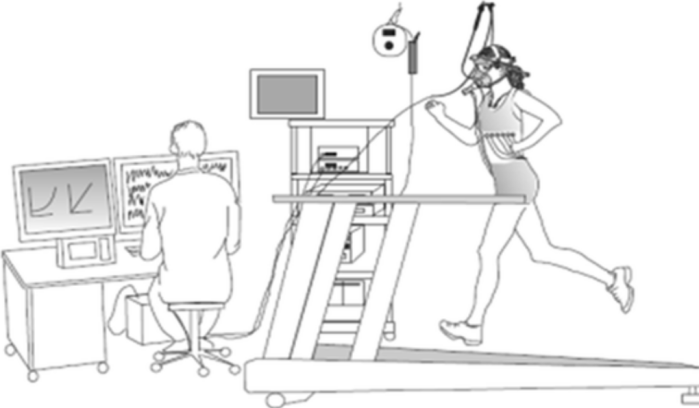
It is currently widely accepted that measuring changes in lung function before and after exercise is the gold standard for diagnosing EIB — namely the "exercise challenge test." This is the most direct and preferred method for diagnosing EIB.
Exercise challenge test: This typically involves 6–10 minutes of cycling or treadmill exercise, raising the heart rate to 80%–90% of the maximum predicted value. If forced expiratory volume in 1 second (FEV1) decreases by 10% or more, the test result is generally considered positive, although a decrease of 15% is more diagnostically significant.
Already diagnosed with asthma: For children who clearly have asthma and develop typical asthma symptoms after exercise, a formal exercise test may not be necessary, unless pre-treatment with inhaled β-receptor agonists fails to relieve or prevent symptoms.
Not yet diagnosed with asthma: For children who have not been diagnosed with asthma, further evaluation helps ensure the cause of breathing difficulty is clearly identified and correct treatment is given.
Additionally, airway hyperresponsiveness can also be assessed through some "surrogate challenge tests," such as eucapnic voluntary hyperventilation testing, and methacholine, histamine, or mannitol inhalation challenge tests.
Depending on equipment availability and clinical needs, these tests can sometimes substitute for exercise challenge tests. This is because some children may still have EIB even with a negative exercise challenge test result, and indirect challenge tests can sometimes detect these "false negative" cases.
Currently, among these surrogate tests, eucapnic voluntary hyperventilation testing is considered to have relatively higher sensitivity for EIB.
For EIB patients who present with typical post-exercise coughing, chest tightness, and breathlessness, a detailed physical examination and medical history can help make the diagnosis. For suspected EIB patients with atypical symptoms, relevant laboratory tests can further confirm the diagnosis.
Furthermore, since differentiation from other conditions that may cause post-exercise breathing discomfort is also necessary — such as the exercise-induced laryngeal dysfunction, vocal cord abnormalities, and glottic structural problems mentioned above, as well as certain cardiac conditions, gastroesophageal reflux-related diseases, or other obstructive and restrictive lung diseases — the doctor may arrange additional tests depending on the specific situation, such as laryngoscopy, gastroscopy, esophageal pH monitoring, or electrocardiogram, to help identify the cause.
References
[1]Paul M O'Byrne, MB FRCP(C) et al.运动诱发的支气管收缩。Up To Date,2024 [2]Rajeev Bhatia, MD; Mutasim Abu-Hasan, MD et al. Exercise-Induced Dyspnea in Children and Adolescents: Differential Diagnosis. PEDIATRIC ANNALS .2019
Disclaimer & Credits
This article was initially drafted with AI assistance, refined by our editorial team, and finalised following professional review by Distinct Healthcare physicians.
This is original content by Distinct Healthcare, provided for informational purposes only and not intended as medical advice. For personalised guidance, please consult a qualified physician.
Contact: health_content@distincthealth.com
Produced by: Distinct Healthcare · Health Express Team
Editorial: Health Express Editorial Team
Medical Review: Distinct Healthcare Physician Team