

Here is a recommended breakfast combination: eggs + milk + whole grains.
For example:
Tea eggs / boiled eggs + milk + corn;
Tea eggs / boiled eggs + oatmeal made with milk;
Tea eggs / boiled eggs + yoghurt + a purple-rice and brown-rice rice ball;
Fried eggs + yoghurt + whole-wheat bread.
These foods are easy to buy and convenient to prepare, making them particularly suitable for people who are short of time in the morning or who usually eat breakfast at the office. If you have more time, you can also add a small handful of nuts, a serving of fruit or a moderate amount of meat to make your breakfast more nutritionally balanced.
This combination not only provides high-quality protein and dietary fibre from whole grains, but also helps fill a nutritional gap that is very easy to overlook: inadequate intake of B vitamins.
Inadequate B-Vitamin Intake Is Very Common
Let us first look at some survey findings.
In 2019, The Lancet Diabetes & Endocrinology published a study. The researchers pooled data from four rounds of national nutrition surveys in China, conducted in 1982, 1992, 2002 and 2010–2012, involving 204,000 adults aged 20 or older, to analyse how Chinese people's diets had changed over 30 years. [1]
The findings showed that:
Fewer than 10% of adults met the minimum recommended intake of dairy products.
More than 80% of adults consumed refined grains in amounts above the recommended upper limit.
In other words, many people's everyday diets contain plenty of refined white rice and flour, few whole grains and not enough milk. Whole grains and dairy products are important sources of several B vitamins.
Another study based on data from the China Health and Nutrition Survey also noted that, in 2015, more than half of adults in China had inadequate vitamin B1 intake, while more than 80% had inadequate vitamin B2 intake. The researchers considered this to be related to dietary changes such as increasingly refined grains and inadequate intake of coarse grains, other grains and dairy products. [3]
Many countries have the same problem. In 2024, The Lancet Global Health published a study covering 185 countries and representing 99.3% of the world's population. The researchers estimated intake of various micronutrients across different countries and population groups. The findings showed that about 55% of people worldwide had inadequate vitamin B2 intake, and about 54% had inadequate folate intake. [2]
Note: Dietary surveys only indicate that intake may be inadequate; they do not mean that people have already developed a vitamin deficiency disorder.
Eggs, Milk and Whole Grains Are Important Sources of B Vitamins
Whole Grains: A Source of Vitamin B1
Vitamin B1 is involved in the body's carbohydrate metabolism (converting carbohydrates into energy) and is also related to the normal functioning of the nervous system.
Vitamin B1 deficiency:
May cause fatigue, reduced appetite, or numbness or tingling in the hands and feet. [5]
Severe deficiency may also affect the heart and nervous system, causing heart failure or Wernicke's encephalopathy (which may present with confusion, an unsteady gait and abnormal eye movements). [5] Severe B1 deficiency is relatively uncommon; people with heavy alcohol consumption, severe malnutrition or a history of weight-loss surgery are at higher risk.
These symptoms are not specific and may also have other causes, so symptoms alone cannot establish whether you have vitamin B1 deficiency. However, if your diet has long been dominated by refined white rice and flour and lacks variety, it is advisable to make adjustments.
The outer layers and germ of whole grains are rich in B1. The refined white rice and flour we commonly eat lose a substantial amount of B1 during dehusking and fine milling.
A review published in the Journal of the American College of Cardiology in 2022 noted that a long-term diet based mainly on refined white rice or other refined grains, with few other B1-rich foods, long-term heavy alcohol consumption and certain diseases are the most important risk factors for vitamin B1 deficiency worldwide. [6]
In addition to eating whole grains at breakfast, it is advisable to include more whole grains and a variety of beans at lunch and dinner, as beans are also an important source of vitamin B1.
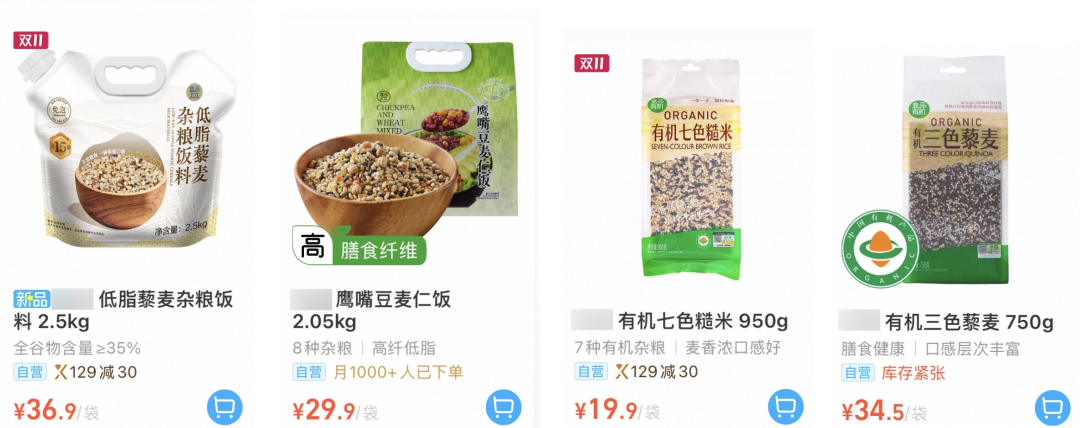
Whole-grain products on a fresh-food shopping platform
Milk + Eggs: Sources of Vitamins B2 and B12
Vitamin B2 helps maintain the normal functions of the skin, mucous membranes and eyes.
Vitamin B2 deficiency:
May cause angular cheilitis (cracking at the corners of the mouth), cheilitis, a red and swollen tongue, or a sore throat. It may also cause light sensitivity, burning and redness in the eyes, as well as a greasy, scaly rash on either side of the nose and around the ears. [7]
These symptoms are not specific and may also have other causes, so symptoms alone cannot establish whether you have vitamin B2 deficiency. However, if you have rarely consumed milk, eggs and meat over a long period, this deserves attention.
Vitamin B12 is involved in red blood cell formation and is also very important for the normal functioning of the nervous system.
Vitamin B12 deficiency:
May cause fatigue, a pale complexion (due to anaemia), a red and painful tongue, and neurological symptoms such as declining memory, difficulty concentrating, numbness and tingling in the hands and feet, and an unsteady gait. [8, 9]
It is particularly important to note that neurological symptoms caused by B12 deficiency can sometimes occur before anaemia develops. [8] If the deficiency goes undetected and uncorrected for a long time, nerve damage may not be fully reversible. [10] People who have followed a vegetarian diet for a long time, older adults, people who have had stomach surgery, and those taking metformin or acid-suppressing medicines long term should be especially attentive. [8]
These symptoms are not specific and may also have other causes, so symptoms alone cannot establish whether you have vitamin B12 deficiency. However, if you have rarely eaten animal foods such as meat, fish, eggs and milk over a long period, it is advisable to make adjustments.
Milk and eggs are both good sources of vitamin B2. The finding mentioned earlier that more than 80% of adults in China had inadequate B2 intake is related to widespread inadequate consumption of dairy products.
Vitamin B2 is water-soluble. Unlike fat-soluble vitamins, it cannot be stored in large amounts in the body; excess amounts are excreted in urine, so it needs to be obtained from the diet every day. The Dietary Guidelines for Chinese Residents (2022) recommend that adults drink 300–500 millilitres of liquid milk every day, or consume an equivalent amount of dairy products, and eat one egg a day (approximately 40–50 g).
Vitamin B12 in natural foods mainly comes from animal foods such as meat, fish, eggs and milk. For people with normal absorption, a sensible daily combination of milk, eggs, fish and meat can generally meet vitamin B12 needs. Vegetarians, older adults and people with impaired gastrointestinal absorption are prone to B12 deficiency and should pay particular attention.
Folate Intake Depends on Lunch, Dinner and Snacks
Folate is vitamin B9, a water-soluble B vitamin involved in blood cell formation and cell growth. Its main sources include dark green leafy vegetables, beans, citrus fruits and animal liver, which need to be included at lunch, dinner and snack time (fruit).
Folate deficiency:
The most common consequence is anaemia, with symptoms such as fatigue, a pale complexion and inflammation of the mouth and tongue. Some people may also experience low mood and declining memory. [11]
These symptoms are not specific and may also have other causes, so symptoms alone cannot establish whether you have folate deficiency. However, if you have rarely eaten fresh vegetables and beans over a long period, it is worth reviewing your diet and including more folate-rich foods, such as dark green vegetables and beans, in your everyday meals.
References
[1]He Y, Li Y, Yang X, Hemler EC, Fang Y, Zhao L, Zhang J, Yang Z, Wang Z, He L, Sun J, Wang DD, Wang J, Piao J, Liang X, Ding G, Hu FB. The dietary transition and its association with cardiometabolic mortality among Chinese adults, 1982-2012: a cross-sectional population-based study. Lancet Diabetes Endocrinol. 2019 Jul;7(7):540-548. doi: 10.1016/S2213-8587(19)30152-4. Epub 2019 May 10. PMID: 31085143; PMCID: PMC7269053.
[2]Passarelli S, Free CM, Shepon A, Beal T, Batis C, Golden CD. Global estimation of dietary micronutrient inadequacies: a modelling analysis. Lancet Glob Health. 2024 Oct;12(10):e1590-e1599. doi: 10.1016/S2214-109X(24)00276-6. Epub 2024 Aug 29. PMID: 39218000; PMCID: PMC11426101. j
[3]Huang, L., Wang, Z., Wang, H. et al. Nutrition transition and related health challenges over decades in China. Eur J Clin Nutr 75, 247–252 (2021). https://doi.org/10.1038/s41430-020-0674-8
[4]Limketkai BN, Matarese LE, Mullin GE. Vitamins and minerals. In: Yamada's Textbook of Gastroenterology. 7th ed. 2022.
[5]Sliwa K, Viljoen CA, Hasan B, Ntusi NAB. Nutritional heart disease and cardiomyopathies: JACC Focus Seminar 4/4. J Am Coll Cardiol. 2022.
[6]Sliwa K, Viljoen CA, Hasan B, Ntusi NAB. Nutritional Heart Disease and Cardiomyopathies: JACC Focus Seminar 4/4. J Am Coll Cardiol. 2022 Dec 7:S0735-1097(22)07308-9. doi: 10.1016/j.jacc.2022.08.812. Epub ahead of print. PMID: 36599756.
[7]Plantone, D., Pardini, M. & Rinaldi, G. Riboflavin in Neurological Diseases: A Narrative Review. Clin Drug Investig 41, 513–527 (2021). https://doi.org/10.1007/s40261-021-01038-1
[8]Patel H, McGuirk R. Vitamin B12 Deficiency: Common Questions and Answers. American Family Physician. 2025.
[9]Stabler SP. Vitamin B12 Deficiency. The New England Journal of Medicine. 2013.
[10]Wolffenbuttel BHR, McCaddon A, Ahmadi KR, Green R. A Brief Overview of the Diagnosis and Treatment of Cobalamin (B12) Deficiency. Food and Nutrition Bulletin. 2024.
[11]Sanford AM. Anaemia in older people. In: Sinclair AJ, Morley JE, Vellas B, Cesari M, Munshi M, editors. Pathy's Principles and Practice of Geriatric Medicine. 6th ed. Wiley; 2022. doi:10.1002/9781119484288.ch22.
Disclaimer & Credits
This article was initially drafted with AI assistance, refined by our editorial team, and finalised following professional review by Distinct Healthcare physicians.
This is original content by Distinct Healthcare, provided for informational purposes only and not intended as medical advice. For personalised guidance, please consult a qualified physician.
Contact: health_content@distincthealth.com
Produced by: Distinct Healthcare · Health Express Team
Editorial: Health Express Editorial Team
Medical Review: Distinct Healthcare Physician Team