
You feel that you are still young, but when you move closer to the mirror, you notice:
That line across your forehead is becoming more and more noticeable;
A few more creases appear at the corners of your eyes when you smile;
Your skin feels a little rough and looks a little dull;
Your cheeks seem less full than before, and your nasolabial folds are becoming noticeable.
Ageing is inevitable, yet there is no shortage of people around us who look several years younger than their actual age. You may find yourself wondering: is it good genes, or good skincare?
In fact, genes and age are indeed among the determining factors, but research has also found that modifiable factors such as sun exposure, smoking, daily routines and diet also affect how quickly the skin starts to look older.
Today, let us look at the science behind how to delay looking older.
First, Understand Why Skin Ages
Skin scientists generally divide skin ageing into two categories:
1. Intrinsic Ageing: Happens over Time and Is Inevitable
As we age, collagen synthesis in the skin decreases, the epidermis becomes thinner and barrier function weakens. The skin becomes dry, loses elasticity and develops fine wrinkles [1].
2. Extrinsic Ageing: Related to the Environment and Habits, and Can Be Partly Addressed
Among extrinsic factors, ultraviolet radiation has the greatest impact. Ageing caused by ultraviolet radiation is called "photoageing".
The following is a classic example.
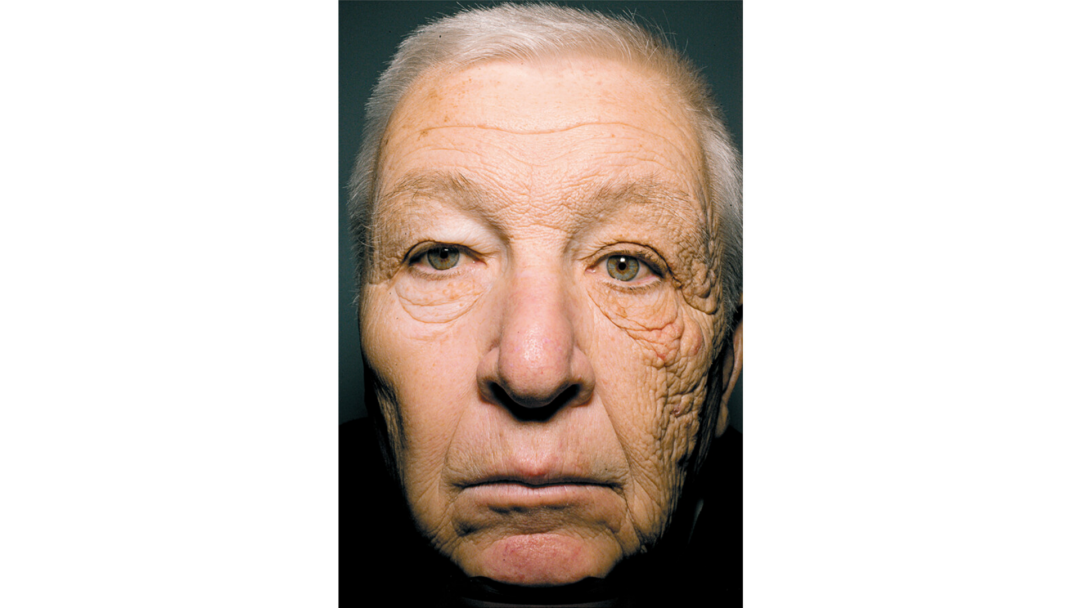
The left and right sides of the same person's face: the left side, which was exposed to sunlight over a long period, has deeper wrinkles and rougher, thicker skin. This is a relatively extreme case of photoageing [2].
In addition to ultraviolet radiation, air pollution, smoking, insufficient sleep, chronic stress and an unhealthy diet are also associated with accelerated skin ageing.
You can also check whether any of these common signs of skin ageing apply to you:
- Fine lines and wrinkles (long-term sun exposure makes deep, coarse wrinkles more likely);
- Reduced elasticity and sagging;
- Dryness and roughness;
- Pigmented spots and uneven skin tone.
How to Delay Skin Ageing
Ageing is inevitable, but consistently maintaining the following habits can help delay looking older as much as possible [3]:
1. Practise consistent sun protection: Sun exposure increases DNA damage and MMP activity and reduces collagen production, making it the primary driver of extrinsic ageing. Daily use of broad-spectrum sunscreen products is recommended, and do not neglect sun protection on cloudy days either!
2. Get sufficient sleep: Insufficient sleep is associated with increased water loss from the skin and reduced skin water content. Good sleep helps the skin barrier repair itself.
3. Eat a balanced diet: Excessive intake of refined sugar and saturated fat may indirectly accelerate skin ageing through glycation and chronic inflammation. A dietary pattern rich in fruit, vegetables, dietary fibre and polyphenols may be more beneficial.
4. Exercise regularly: Exercise helps improve the skin's microcirculation and cellular energy metabolism.
5. Stop smoking and manage stress: Smoking increases MMP-1, which breaks down collagen; chronic stress increases inflammation levels.
6. Take a science-based approach to skincare: Use gentle cleansing, moisturising and barrier-repair care, together with anti-ageing ingredients supported by evidence.
The Unique Value of Retinoids in Anti-Ageing Skincare
Among topical ingredients used to improve photoageing, retinoids have long been called the "gold standard" of topical anti-ageing care because the evidence supporting them is relatively robust [4].
- A network meta-analysis including 23 randomised controlled trials showed that retinoids such as retinol can significantly improve facial fine lines, and that retinol also improves hyperpigmentation [5].
- A Delphi consensus study published in 2025 in JAAD, a leading journal in dermatology, showed that, among more than 300 commonly used active skincare ingredients, dozens of dermatology experts reached a consensus on 23. Among these, retinoids were recommended for 5 types of concerns—fine lines and wrinkles, acne, pigmented spots, enlarged pores and oily skin—making them one of the ingredients that address the widest range of concerns [6].
However, retinoids are a large family with more than one member. In everyday skincare products, retinol is one of the most common and relatively well-studied retinoids. Let us now focus on retinol.
1. How Retinol Works
Retinol itself is not the final active form. After it is applied to the skin, enzymes in the skin gradually convert it: retinol → retinaldehyde → retinoic acid.
Retinoic acid enters the cell nucleus and binds to specific receptors, regulating a series of genes involved in skin renewal and collagen metabolism:
It promotes collagen production (including type I and type VII collagen) while inhibiting MMPs that break down collagen, helping to make fine lines shallower and the skin firmer.
It promotes the rebuilding of elastic fibres, helping to improve elasticity.
It promotes epidermal renewal, making the skin smoother.
It reduces melanin in the epidermis, helping to improve pigmented spots and uneven skin tone.
2. How to Choose a Retinol Concentration
- Low concentrations (below 0.1%): Suitable for sensitive skin or first-time users.
- Moderate concentrations (0.1%-0.3%): Balance effectiveness and tolerability.
- The higher the concentration, the more common irritation becomes: At higher concentrations, some people may experience redness and peeling.
- A 24-week study found that different concentrations of retinol could all improve skin roughness. Higher concentrations worked faster, but by week 24, there was little difference between concentrations in their improvement of skin roughness [7].
So, with retinol, consistent use is more important than simply pursuing a high concentration.
3. Who Is Retinol Suitable For?
- Suitable for: Adults with signs of photoageing, such as fine lines, roughness, dullness and pigmented spots.
- Use with caution: People with sensitive skin or an impaired skin barrier are advised to begin with less frequent use.
- Not recommended for: Women who are pregnant, planning a pregnancy or breastfeeding.
Topical retinol is mainly used for routine maintenance and to improve mild-to-moderate fine lines and skin texture concerns. For deeper wrinkles and pronounced sagging, medical aesthetic procedures such as lasers and injections can often address concerns that skincare products struggle to improve. However, a proper at-home skincare routine can also help optimise the results of medical aesthetic procedures; consistency is key.
- This A+C+E combination has been explored in clinical studies: a 12-week open-label study found that combining retinol with a vitamin C derivative and vitamin E led to marked improvements in all measures of photoageing and hyperpigmentation in the participants [8].
- A review noted that combining retinol with antioxidant ingredients such as vitamin C and vitamin E may help reduce irritation and strengthen the skin's defences against environmental damage such as ultraviolet radiation [9]. However, this conclusion is currently based mainly on mechanisms of action, and more human studies are needed to validate it.
To maximise the effects of retinol, you need to know how to use it correctly—
- Use only at night: After cleansing, take a soybean-sized amount and apply it evenly over the entire face. Be sure to use sun protection during the day.
- Start with less frequent use: Begin by using it once every 2–3 nights. Once your skin tolerates it, you can gradually increase the frequency according to your individual circumstances. Before first use, perform a patch test behind the ear.
- If you are concerned about irritation, use the "sandwich buffering method": Apply a layer of moisturiser first, then apply the retinol night cream.
Frequently Asked Questions (FAQ)
Q: Can I use retinol if I want to address early ageing but do not yet have wrinkles?
A: Yes, and this is actually the ideal time to start. Retinol improves and delays photoageing by stimulating collagen synthesis, removing degenerated elastic fibres and promoting epidermal renewal, so you do not need to wait until wrinkles appear before using it. In fact, most anti-ageing benefits come from long-term consistent use; the earlier you begin using it regularly, the better you can maintain your skin's condition before fine lines actually form.
Q: How long does it take to see results from retinol?
A: Anti-ageing care requires patience. Improvements in wrinkles and skin texture may generally appear after 8–12 weeks of using retinol products. Results vary from person to person, and consistent use is more important than pursuing a high concentration.
Q: Can retinol be used with other skincare products?
A: Moisturising and barrier-repair products (such as those containing ceramides or hyaluronic acid) can generally be used alongside retinol. As far as possible, avoid layering potentially irritating ingredients such as high-concentration alpha hydroxy acids, salicylic acid and L-ascorbic acid on the same evening.
References
1. de Afonso Bonotto NC, Musachio E, Felin GD, Felin GD, Schwanke CHA, da Cruz IBM, Barbisan F. Skin Aging and Mitochondrial Dysfunction: Structural Changes, Mechanistic Insights, and Therapeutic Perspectives. Oxid Med Cell Longev. 2026;2026(1):e5140711. doi: 10.1155/omcl/5140711. PMID: 42133650; PMCID: PMC13175270.
2. Gordon JR, Brieva JC. Images in clinical medicine. Unilateral dermatoheliosis. N Engl J Med. 2012 Apr 19;366(16):e25. doi: 10.1056/NEJMicm1104059. PMID: 22512500.
3. Piquero-Casals J, Cruz AR, Ponti-Concetti L, Prudkin L, Brown A, Foyaca M, Rozas-Muñoz E, Mir-Bonafé JF, Morgado-Carrasco D, Passeron T. The impact of the six pillars of lifestyle medicine on the biology of skin aging. Front Aging. 2026 Jun 17;7:1822471. doi: 10.3389/fragi.2026.1822471. PMID: 42389732; PMCID: PMC13318866.
4. Kaltchenko MV, Chien AL. Photoaging: Current Concepts on Molecular Mechanisms, Prevention, and Treatment. Am J Clin Dermatol. 2025 May;26(3):321-344. doi: 10.1007/s40257-025-00933-z. Epub 2025 Mar 12. PMID: 40072791.
5. Lin L, Chen X, Liu C, Wang Q, Lian W, Xu X, Guo Y, Zhong H, Zhong J, Zhao N, Cheng W, Shu P, Xu Z. Comparative efficacy of topical interventions for facial photoaging: a network meta-analysis. Sci Rep. 2025 Jul 24;15(1):26889. doi: 10.1038/s41598-025-12597-0. PMID: 40707570; PMCID: PMC12289910.
6. Alvarez GV, Kang BY, Richmond AM, Hoss E, Sulewski R, Minkis K, Rozenberg SS, Antonovich D, Boucher A, Bernstein EF, Bertucci V, Chapas AM, Cohen JL, Council ML, Dover JS, Geronemus R, Given KML, Goldbach HS, Goldman MP, Hooper D, Kaufman J, Munavalli G, Pacheco TR, Rossi AM, Wilson S, Alam M. Skincare ingredients recommended by cosmetic dermatologists: A Delphi consensus study. J Am Acad Dermatol. 2025 Dec;93(6):1509-1525. doi: 10.1016/j.jaad.2025.04.021. Epub 2025 Apr 14. PMID: 40233838.
7. Jang SI, Jung YC, Suk J, Lee S, Han J, Suh BF, Kim E. A long term study of the difference in efficacy and effect rate of various concentrations of retinol (1500-6600 IU) in middle aged women. Arch Dermatol Res. 2023 Jul;315(5):1323-1332. doi: 10.1007/s00403-022-02520-2. Epub 2022 Dec 27. PMID: 36574043.
8. Herndon JH Jr, Jiang LI, Kononov T, Fox T. An Open Label Clinical Trial to Evaluate the Efficacy and Tolerance of a Retinol and Vitamin C Facial Regimen in Women With Mild-to-Moderate Hyperpigmentation and Photodamaged Facial Skin. J Drugs Dermatol. 2016 Apr;15(4):476-82. PMID: 27050703.
9. Al-Dhubaibi, M.S., Mohammed, G.F., Atef, L.M. et al. The role of antioxidants in dermatology: from diet to topical applications. Arch Dermatol Res 318, 376 (2026). https://doi.org/10.1007/s00403-026-04830-1
Disclaimer & Credits
This article was initially drafted with AI assistance, refined by our editorial team, and finalised following professional review by Distinct Healthcare physicians.
This is original content by Distinct Healthcare, provided for informational purposes only and not intended as medical advice. For personalised guidance, please consult a qualified physician.
Contact: health_content@distincthealth.com
Produced by: Distinct Healthcare · Health Express Team
Editorial: Health Express Editorial Team
Medical Review: Distinct Healthcare Physician Team