
A collision on the sports field, a fall from a bicycle, or slipping in the rain and hitting a step—one accident can knock an entire tooth right out. This does not only happen to children; adults can experience it too.
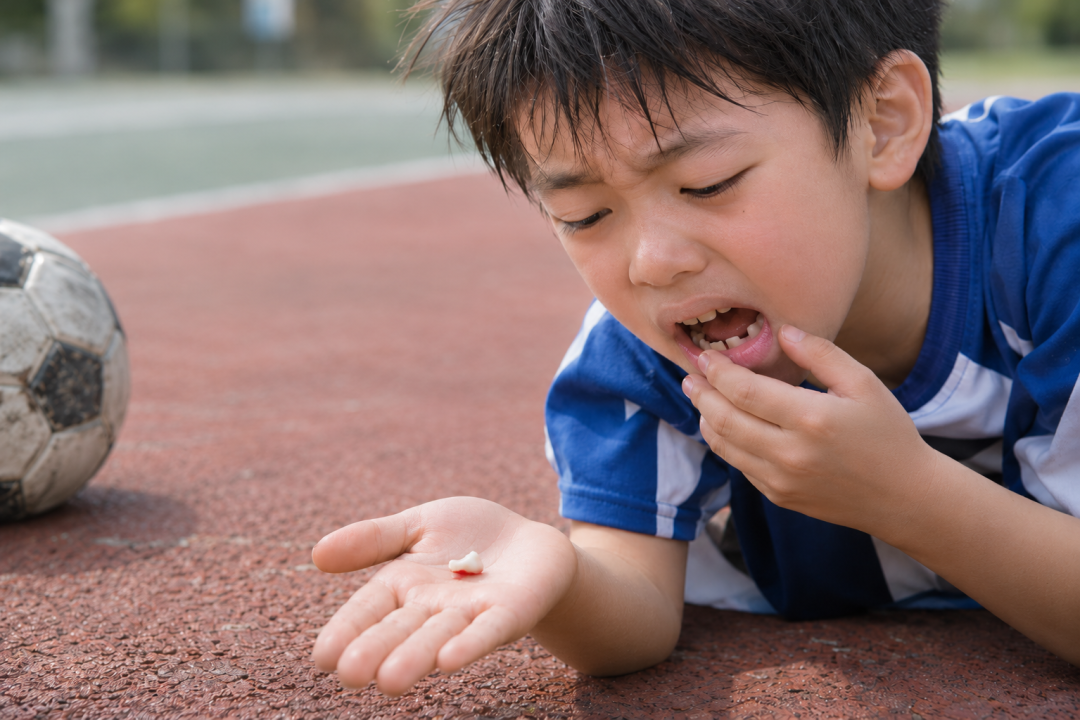
Many people's first reaction is, ‘Quickly pick it up, wipe it clean, and wrap it in a clean tissue.’ But doing this can actually compromise subsequent treatment. What really determines whether the tooth can be saved is not how clean it looks, but how many living periodontal ligament cells remain on its root.
The International Association of Dental Traumatology (IADT) 2020 guidelines and real-world five-year follow-up data both point to two key factors: how long the tooth has been dry, and whether it has been kept in an appropriate storage medium after being knocked out.
Today, we will explain what to do if a tooth is knocked out, to help save it!
Here is a summary of the article's key points—save it for reference!
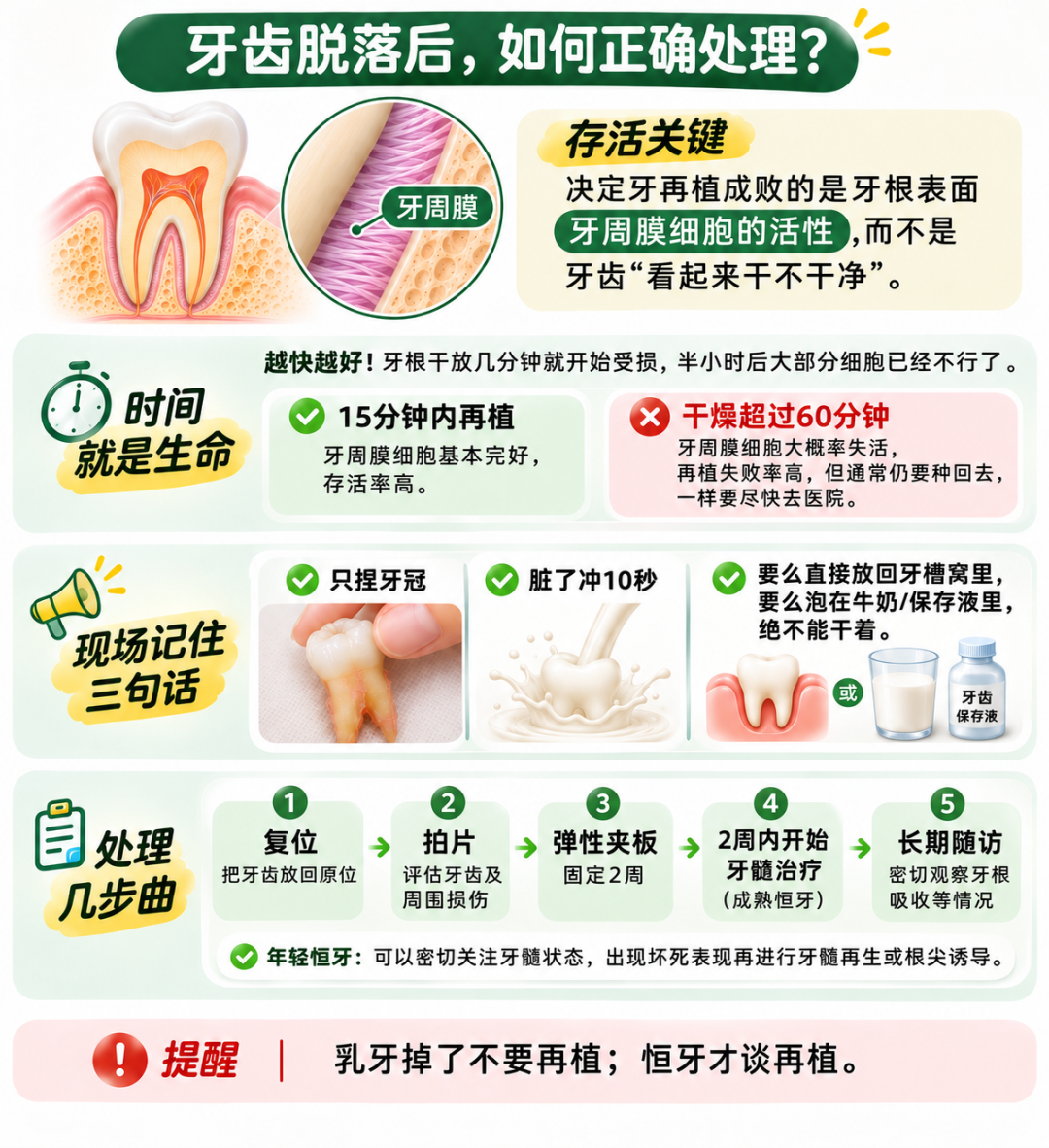
1. When a Tooth Is Knocked Out, What Are We Actually Trying to Save?
A tooth stays firmly in the alveolar bone not because it is ‘wedged in tightly,’ but because of a thin layer of periodontal ligament covering the root surface. This layer contains fibroblasts, undifferentiated cells, and a network of blood vessels.
It anchors the root to the bone and also senses the forces exerted when you bite.
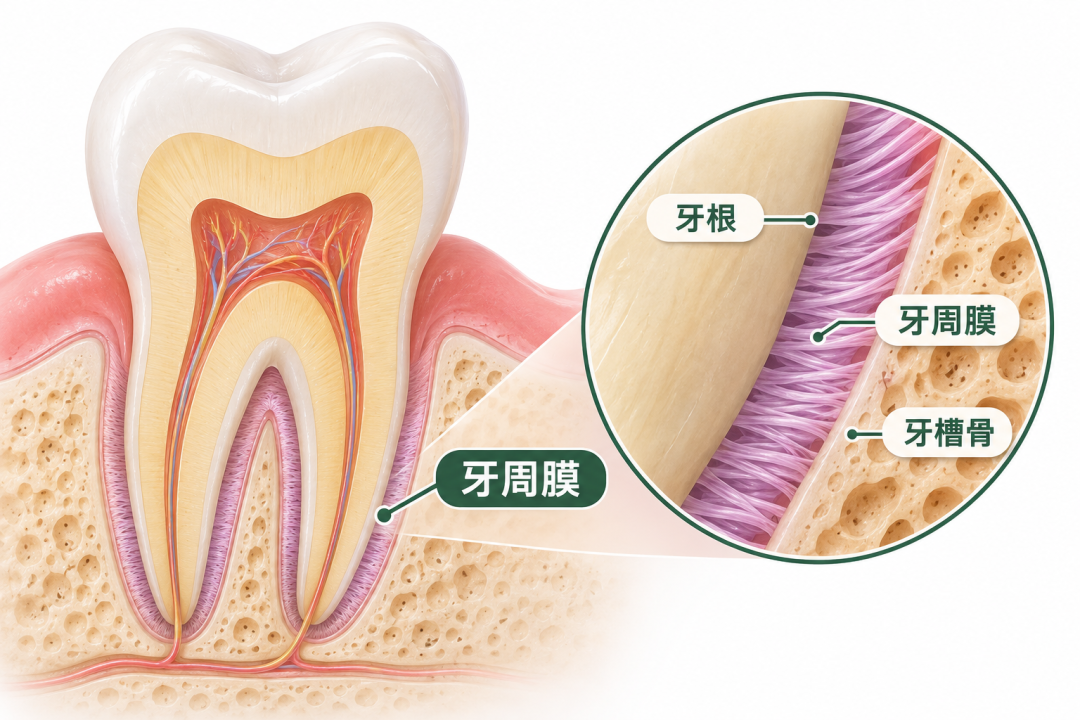
When an entire tooth is knocked out—clinically known as tooth avulsion—these cells are essentially torn out and exposed to the air. What they fear most is drying out: the cells become dehydrated and rupture.
Once the cells on the root surface lose their viability, the periodontal ligament can no longer heal after the tooth is replanted. The root then fuses directly with the surrounding bone and is gradually resorbed and replaced by bone tissue.
The IADT 2020 guidelines for traumatic injuries to permanent teeth divide tooth avulsion into three categories [1]:
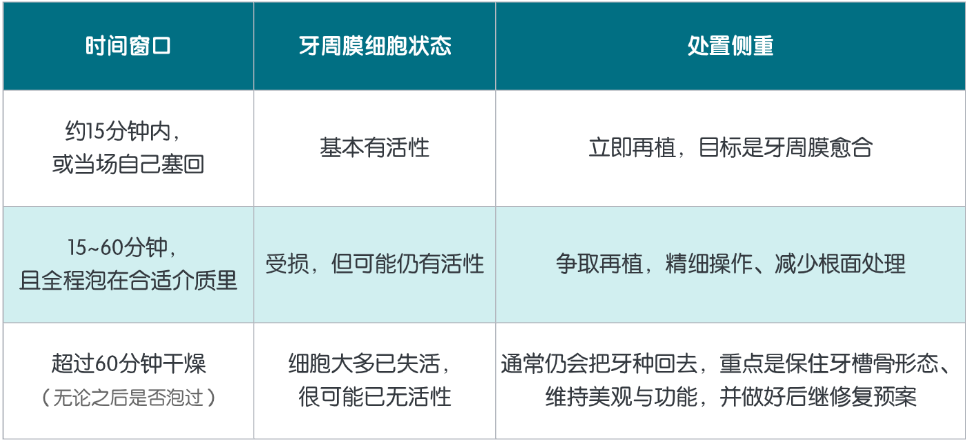
The guidelines themselves are careful in their wording: following them does not guarantee the outcome, but it can maximize the likelihood of a favorable result. Claims such as ‘guaranteed to save the tooth’ or ‘fixed in one go’ are therefore not evidence-based statements.
2. How Long Can a Replanted Tooth Last?
A retrospective study of 62 replanted permanent teeth, all followed for a full five years, reported the following results [4]: with appropriate management, about half of the replanted teeth were still present after five years; the earlier a tooth was replanted, the greater its chance of being retained.
- Still present in the mouth after five years: approximately 50%.
- Of the 25 teeth replanted within 60 minutes, 16 (64%) were still in use at five years.
- Among the teeth that were eventually extracted, 71% had spent more than 60 minutes out of the mouth.
These data also show that even with standard management, a substantial proportion of replanted teeth are still lost several years later because of root resorption.
That is why doctors do not talk about ‘saving it forever,’ but about ‘keeping it for as long as possible while preserving your bone volume and keeping your options open.’
‘Preserving bone volume’ is particularly important for adolescents and young people: dental implant restoration is not appropriate before growth of the jaws and face is complete. Keeping the person's own tooth—even if only for a number of years—helps maintain the width and height of the alveolar bone, providing a better foundation for restoration in adulthood [1,4].
3. Five First-Aid Steps at the Scene: How to Handle a Knocked-Out Tooth Correctly
Step 1: Find the Tooth
First, establish where the tooth is, whether it has been broken by biting, and whether it has entered the airway or been swallowed into the stomach. These possibilities must be ruled out first in children.
If it is a child's primary (baby) tooth, do not put it back. Simply take the child to see a doctor.
Important: do not overlook the condition of the head and neck or the rest of the body. In trauma care, the order is always ‘the person first, the tooth second’ [5].
Step 2: Hold Only the Crown
Once you find the knocked-out tooth, identify its parts: the white end is the crown, while the slightly yellower part with ‘strands of tissue’ attached is the root.
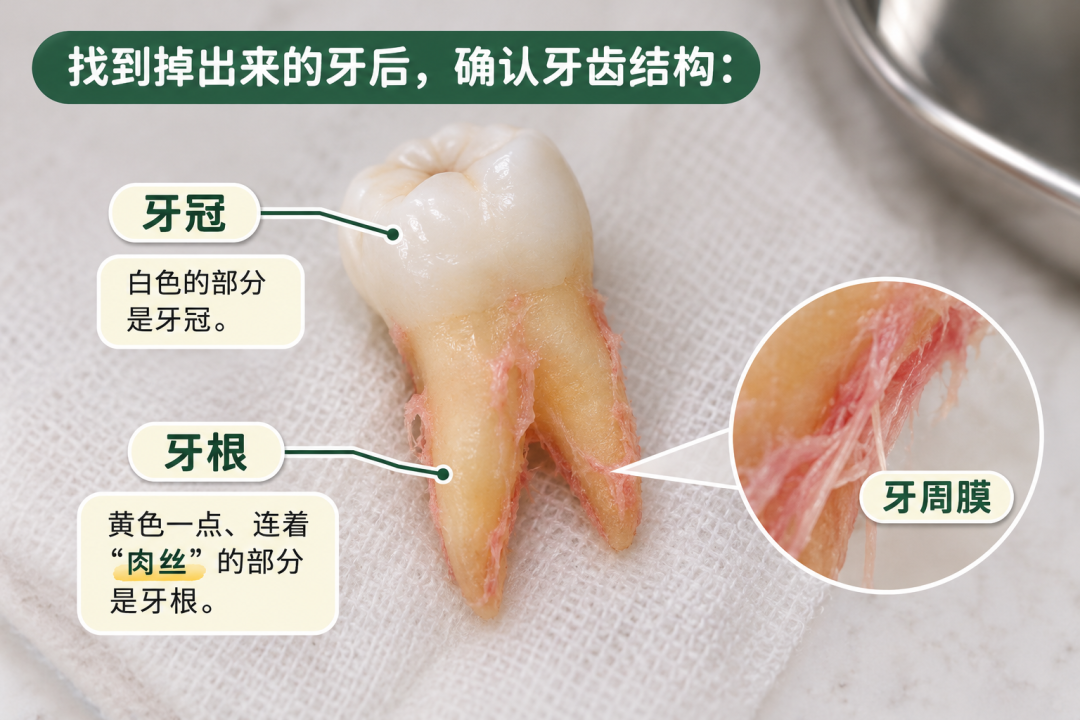
Whether using fingers, gauze, or tweezers, hold or grasp only the crown. Do not rub the root surface. Under no circumstances should you pick at, scrape, or wipe the root surface [1].
Step 3: If It Is Dirty, Rinse for 10 Seconds
If the tooth has landed in mud or on rubber granules on a sports field, gently rinse it with milk, normal saline, or clean water for about 10 seconds. Removing the surface dirt is enough.
The guidelines explicitly advise against using instruments to scrape the root surface. Blood clots or dirt firmly attached to the root surface can be left for the dental team to deal with when you arrive [1].
Step 4: If You Can Put It Back, Do So
Provided that the injured person is conscious and able to cooperate, and the tooth is intact, check which way the tooth faces and gently press it back into its socket in its original orientation, allowing the teeth to come together naturally. Alternatively, have the person bite on clean gauze or a handkerchief to hold it in place. Then set off for medical care immediately.
The guidelines state that if the tooth can be put back at the scene, it should be put back immediately. Do not leave it dry while waiting to reach the hospital [1].
Step 5: If You Cannot Put It Back, Keep It in Liquid
Liquids that can be used to store the tooth include:
- Hank's balanced salt solution (HBSS-type solutions): the most consistent at preserving cell viability [2,3]. The drawback is that it is not readily available.
- Plain milk (cold or at room temperature): its osmotic pressure and pH are relatively favorable, it is readily available, and it can also be used to clean the root surface [1,2].
- The patient's own saliva (holding the tooth inside the cheek, or spitting into a cup and keeping the tooth in it): do not use the inside-the-mouth method for children, people who are not fully conscious, or people who are intoxicated, because of the risk of accidental swallowing and choking [2].
- Normal saline: a temporary fallback; it does not perform as well as milk on measures of cell viability [2].
Important: do not store the tooth dry—for example, in a tissue, a handkerchief, or an empty pocket. Doing so is effectively ‘giving up on the cells’ [1,2].
Once the tooth is in liquid, do not repeatedly change the liquid or rinse the tooth again. Go to a dental emergency service immediately, taking both the tooth and the liquid it is stored in.
In addition to a whole tooth being knocked out, the following situations also require an immediate emergency visit:
- A tooth fragment is suspected to have entered the airway or been swallowed;
- A tooth has been driven into the bone;
- A tooth is loose or displaced, or the bite has changed;
- There is extensive tearing of the gums, or an injury to the chin or face;
- The person is not fully conscious or is vomiting.
A note on seeking care: this article provides general health education and cannot replace an in-person consultation. The management of dental trauma depends heavily on individual circumstances, including how long the tooth has been out of the mouth, the stage of root development, and whether there is an associated fracture. This article does not recommend any self-medication; all medications and procedures must be decided by the treating doctor.
If you are unsure ‘whether this tooth is still worth trying to save,’ give the doctor three pieces of information: the exact time it was knocked out, how long it was dry afterward, and what it was kept in during that time.
4. Four Common Mistakes
- Wrapping the tooth in a tissue or dry gauze—the most common mistake, and the one that is most destructive to the cells.
- Soaking the tooth in alcohol, povidone-iodine, hydrogen peroxide, or mouthwash to disinfect it—these severely damage the cells on the root. Do not use them. The guidelines do not recommend treating the root surface with any medication [1].
- Scrubbing the root clean with a toothbrush—what you brush away is the periodontal ligament, which is the key to successful replantation.
- ‘The tooth is gone, so just wait for an implant’—this leads to permanent tooth loss, loss of bone volume, and more expensive treatment. The injured site often also needs bone grafting first.
5. The Tooth Replantation Process
After a tooth has been knocked out, what further treatment will usually be carried out at the hospital?
1. Assessment
Check vital signs and look for associated injuries; record the cause of the injury and the precise time the tooth has been out of the mouth; carry out clinical and imaging examinations (periapical radiographs, or CBCT if necessary); and assess for an associated alveolar bone fracture, the condition of neighboring teeth, and the bite [1,5].
2. Repositioning and Splinting
Under local anesthesia, gently clean the socket, reposition the tooth, and use imaging to verify its position. Stabilize it with a flexible or semi-flexible splint for about 2 weeks. If there is an associated alveolar bone fracture, extend this to 4 weeks; immature permanent teeth that have been dry for too long may also be splinted for up to 4 weeks [1,5].
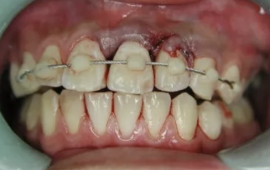
Image sourced from the internet.
3. Infection Control and Immunization
The doctor decides whether antibiotics, pain medication, and tetanus management are needed, based on the degree of wound contamination and the person's immunization history [1].
4. Pulp Treatment
For mature permanent teeth whose apical opening has closed, pulp treatment is carried out within 2 weeks after replantation to reduce inflammatory resorption caused by necrotic pulp [1].
5. Bite and Diet
Adjust the bite to reduce the load on the affected tooth. Usually, eat soft foods for the first few weeks, brush with a soft-bristled toothbrush after meals, use mouthwash as directed by the doctor, and pause contact sports [1,5].
6. Follow-Up
Attend several follow-up visits during the first year as arranged by the doctor—for example, at 2 weeks, 4 weeks, 3 months, 6 months, and 1 year—then once a year, continuing follow-up for at least 5 years. Children need more frequent reviews.
Have regular radiographs to monitor for root resorption, ankylosis, periapical lesions, and other changes [5].
6. Good Prevention Is the Most Cost-Effective Approach
A mouthguard is recommended for contact or high-risk activities such as basketball, football, cycling, skateboarding, and combat sports. Ready-made or custom-made mouthguards can both be used, although custom-made ones fit better. This is one of the best-supported measures for the primary prevention of dental trauma [1] and can effectively prevent severe dental injuries.
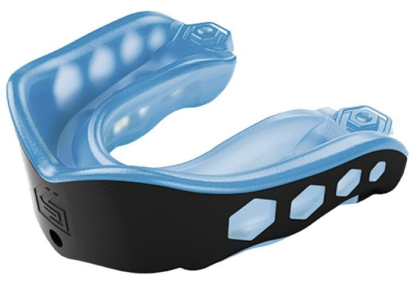
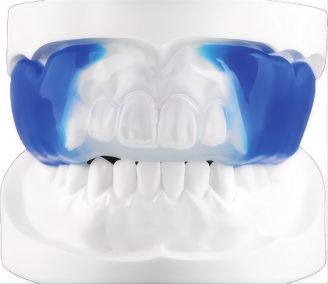
People undergoing orthodontic treatment must address the additional risk of injury from brackets and wires during sports; confirm a plan for protecting the teeth with the doctor. Prevent slips at home and avoid sharp corners and edges in children's play areas. People whose upper front teeth protrude noticeably—commonly called ‘buck teeth’—have a higher risk of trauma, and this can be included in an orthodontic assessment.
Finally, remember:
If a tooth is knocked out, hold only the crown; if it is dirty, rinse for 10 seconds; put it back if you can; if you cannot, keep it in milk; then get to a dental emergency service quickly!
References
[1] Fouad AF, Abbott PV, Tsilingaridis G, et al. International Association of Dental Traumatology guidelines for the management of traumatic dental injuries: 2. Avulsion of permanent teeth[J]. Dental Traumatology, 2020, 36(4): 331-342. DOI: 10.1111/edt.12573.
[2] De Brier N, O'Donnell D, Borra V, Singletary EM, Zideman DA, De Buck E. Storage of an avulsed tooth prior to replantation: A systematic review and meta-analysis[J]. Dental Traumatology, 2020, 36(5): 453-476. DOI: 10.1111/edt.12564.
[3] Blackledge CA, Ferrer Molina M, Hijazi Alsadi T, Muwaquet Rodriguez S. The Comparison Between the Different Types of Storage Mediums on the Viability of Periodontal Cells Prior to the Replantation of Avulsed Teeth: A Systematic Review & Meta-Analysis[J]. Journal of Clinical Medicine, 2025, 14(6): 1986. DOI: 10.3390/jcm14061986.
[4] Roskamp L, Perin CP, Castro JP, et al. Retrospective analysis of survival of avulsed and replanted permanent teeth according to 2012 or 2020 IADT Guidelines[J]. Brazilian Dental Journal, 2023, 34(2): 122-128. DOI: 10.1590/0103-6440202305255.
[5] 中华口腔医学会. 恒牙外伤牙固定术技术专家共识:T/CHSA 009—2022[S]. 2022.
Author & Medical Reviewer
Author: Dr Hechuan Zhao, Distinct Healthcare.
Expert reviewer: Dr Yin Wu.
Dentist at Distinct Healthcare; master's degree from the School of Stomatology, Wuhan University.
Disclaimer & Credits
This article was initially drafted with AI assistance, refined by our editorial team, and finalised following professional review by Distinct Healthcare physicians.
This is original content by Distinct Healthcare, provided for informational purposes only and not intended as medical advice. For personalised guidance, please consult a qualified physician.
Contact: health_content@distincthealth.com
Produced by: Distinct Healthcare · Health Express Team
Editorial: Health Express Editorial Team
Medical Review: Distinct Healthcare Physician Team