
Many people come into the clinic and, as soon as they sit down, anxiously ask:
“Doctor, I feel as if I have aged a lot all of a sudden recently. What can I do?”
“Doctor, look at my face. Is the sagging particularly obvious?”
When people feel that they have “suddenly aged”, their first thought is often “collagen loss”. For example, fine lines around the eyes or double eyelids becoming “multiple eyelid folds” may be related to laxity caused by reduced collagen in the skin around the eyes and thinning of the dermis.
In fact, facial ageing occurs at three levels, and collagen loss is only one of them. The impression that a face has “suddenly sagged a lot” is more often the combined result of signs of ageing at different levels.
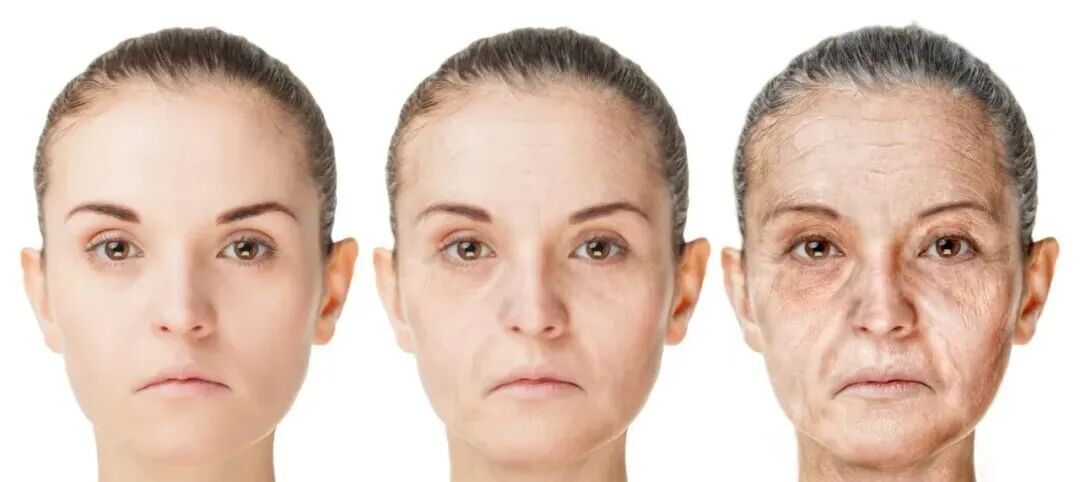
The three levels of facial ageing:
1. Deterioration in the texture of the surface skin: common signs include dry fine lines and enlarged pores.
2. Breakdown of collagen and elastic fibres in the dermis: this is like the “elastic net” supporting the skin becoming loose. It can deepen nasolabial folds and marionette lines and cause a noticeable downward shift in the face's centre of gravity (an inverted triangle becoming an upright triangle).
3. Atrophy of the deeper bones and fat pads: this means volume loss, or what people describe as the “foundation collapsing”. For example, hollows in the temples and tear troughs become more obvious, and the midface shows more noticeable sagging.
To address ageing, we generally have three types of strategy: restoring volume, stimulating regeneration, and lifting and tightening.
You can choose whichever sections interest you. Although there are many methods, we hope people achieve reasonable, effective improvements rather than a result in which “too much is as bad as too little”.
01. Restoring Volume: Directly Replacing Lost Tissue Beneath the Skin
Simply put, this means supporting the areas that have “collapsed”. It is like inflating a slightly deflated ball so that it quickly becomes full again and its contours become smooth.
The main materials currently used fall into three broad categories:
Hyaluronic Acid
This is probably the material most people know best. Its mechanism is simple: it provides immediate filling by physically occupying space. It is suitable for improving hollows and enhancing contours, and its effects usually last 6–18 months.
There are many types of hyaluronic acid. You may have heard descriptions such as using a “firm” type for shaping, a “soft” type for adding fullness and a “thin” type for hydration. This is like using flour as an ingredient: different cooking methods can produce soft steamed buns, chewy noodles or crisp biscuits.
The variety of hyaluronic acid products is mainly achieved through “cross-linking technology” and “particle sieving”. These produce products with different elastic moduli (support), cohesiveness (shaping) and viscosity (spreadability), to mimic the properties of different skin structures, such as bone and fat.
Poly-L-Lactic Acid (PLLA)
This name is harder to remember, but it is the material used in the product commonly called a “youthful-face injection” (童颜针). Its mechanism is not simply to occupy space physically.
PLLA is a material with good biocompatibility. However, after it is injected into the body, it triggers a mild immune response, prompting immune cells to gather in the injection area. During this process, the immune cells release a range of cytokines, which activate fibroblasts in that area.
This is exactly the response we make use of: the activated fibroblasts begin to proliferate and synthesise new collagen. Over several months, they can gradually form a network that supports and improves the skin's firmness and thickness, creating natural fullness.
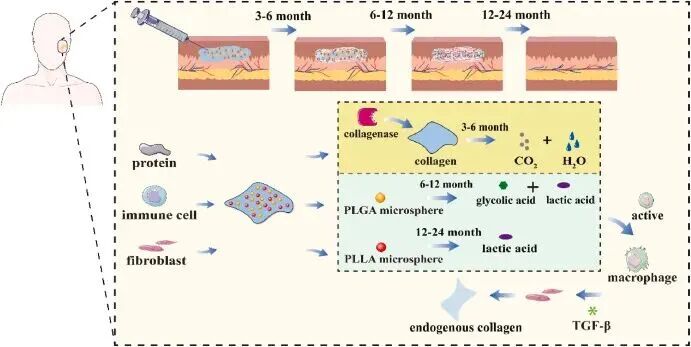
Image source: Reference [4]
At the same time, the injected PLLA microspheres gradually break down into lactic acid through hydrolysis and are ultimately metabolised and cleared by the body.
Note: This improvement in volume is gradual. The effects gradually become apparent after several months and also last longer.
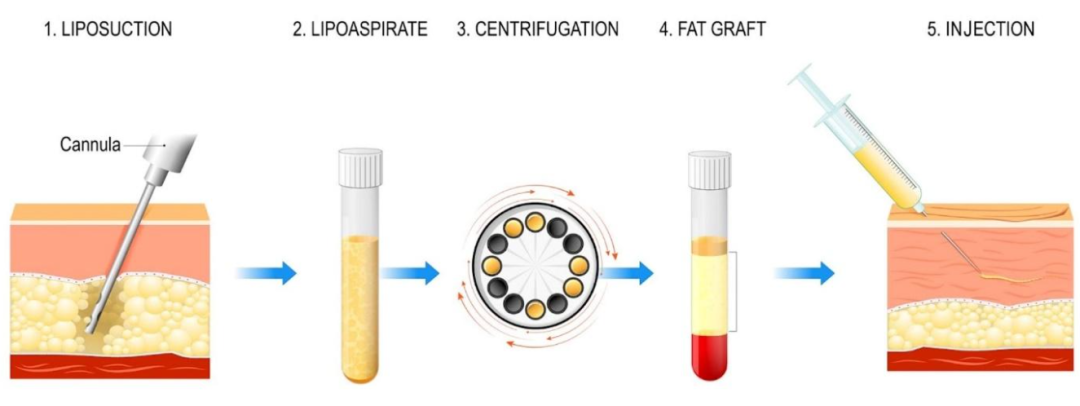
Autologous Fat
Simply put, your own fat cells are purified and then transplanted into the face. Once the fat cells survive, the effects are permanent, and the texture is very natural.
However, this requires surgery to extract the fat, and the transplanted fat cells also face the issue of their “survival rate”.
This is also an opportunity to remind everyone not to pursue an excessively low body fat percentage. When the body starts breaking down fat, it does not use fat from just one area; the process takes place throughout the body at the same time. Therefore, when losing weight by “cutting fat”, facial fat also decreases, and localised hollows may appear.
02. Stimulating Regeneration: Activating the Skin's Ability to Repair Itself
This is a more active strategy. Its core mechanism is to use controlled energy or physical stimulation to create micro-injuries deep in the skin, thereby activating the skin's powerful ability to repair itself.
During repair, the body “instructs” fibroblasts to produce large amounts of densely arranged collagen and elastic fibres. These measures can therefore fundamentally increase the density of the dermis and tighten its supporting structures, creating a feeling of fullness and firmness.
Representative treatments include Thermage, high-energy focused ultrasound (大超炮), fractional laser, gold microneedling, and injections of type III collagen.
Thermage
The principle is to deliver radiofrequency energy precisely to the dermis and subcutaneous fibrous septa. The thermal effect causes existing collagen fibres to contract immediately and stimulates new collagen over the long term, thereby producing tightening.
Many people feel that their “face immediately became a size smaller” after Thermage. This is mainly because the subcutaneous fibrous septa tighten under the effect of heat, lifting lax soft tissue upwards and making the facial contours clearer, which creates the impression of a “slimmer face”.
This is only the beginning. As your own collagen continues to regenerate and reorganise over the 3–6 months after treatment, the rejuvenating effect gradually reaches its peak.
High-Energy Focused Ultrasound (大超炮)
The principle is to focus ultrasound energy at different levels beneath the skin, including the key SMAS fascial layer. Creating tiny thermal coagulation points produces deeper lifting and tightening.
Fractional Laser and Gold Microneedling
Both work by creating tiny channels in the skin to trigger a repair response. This improves skin texture, refines pores and reduces fine lines, enhancing the skin's overall radiance and smoothness. They are particularly suitable for oily skin with enlarged pores and a tendency to develop acne.
Note: Treatment requires a period of recovery, and its effects also depend on continuing collagen remodelling.
Type III Collagen Injections
Injecting collagen can bypass the process in which light, sound or electrical stimulation triggers an inflammatory response, directly increasing collagen levels. However, it is often metabolised within a relatively short time.
Type III collagen is relatively unusual. It is a protein with extensive biological regulatory activity and can stimulate the skin's own synthesis of type I and type III collagen before it breaks down itself.
In addition, some of the amino acids released as type III collagen breaks down can bind competitively to tyrosinase, reducing melanin synthesis and producing a whitening and brightening effect.
03. Lifting and Tightening: For Noticeable Laxity and Sagging
This means a “thread lift”. The core mechanism involves placing absorbable lifting threads beneath the skin, with two effects:
Physical lifting: barbs or cones on the threads physically catch and lift lax tissue, immediately repositioning it.
Collagen regeneration: the threads themselves also act as a scaffold to induce collagen regeneration, providing ongoing tightening.
The treatment has an immediate effect, but it usually lasts 1–2 years, as the thread material gradually breaks down.
Its safety, however, depends heavily on the doctor's technique and precise understanding of the layers of facial anatomy.
The face has a rich network of blood vessels and nerve branches. Its layers vary considerably between people of different ages and sexes and with different fat-layer thicknesses. The doctor needs to use the course of the anatomy to identify safe channels and fixation points, so that the lift is effective without causing injury.
Summary
In clinical practice, we often use combined approaches based on the specific condition of the face. For example, we often encounter facial laxity together with localised volume loss, for which a single treatment has limited effects. We can use Thermage to tighten the face, then combine it with hyaluronic acid or PLLA to “fine-tune” volume in particular areas. This creates a synergistic effect of 1 + 1 > 2, addressing both firmness and fullness.
Note: If localised PLLA volume filling and light- or energy-based treatment are scheduled for the same day, it is generally recommended to have the light- or energy-based treatment (such as Thermage) first, followed by filling. If PLLA filling has already been performed, radiofrequency treatment may be considered one month later. This allows PLLA to activate fibroblasts first, before radiofrequency treatment enhances the overall anti-ageing effect.
At present, no single medical aesthetic treatment can do everything. Ideal improvements must be based on a professional, precise assessment and an individually designed plan.
We hope the framework in this article helps you communicate more effectively with your treating doctor and find a safe, effective approach to improving your appearance that suits you.
References
[1]Ximeng Jia, Yongqiang Feng. Energy-Based Skin Rejuvenation: A Review of Mechanisms and Thermal Effects. J Cosmet Dermatol. 2025; 24(2): e16657.
[2]Seyeon Oh1, Je Hyuk Lee, Hyoung Moon Kim et al. Poly-L-Lactic Acid Fillers Improved Dermal Collagen Synthesis by Modulating M2 Macrophage Polarization in Aged Animal Skin. Cells 2023, 12, 1320.
[3]Kim YU, Gi HJ, Jeong EK, et al. Development of a highly effective recombinant protein from human collagen type III alpha 1 to enhance human skin cell functionality. BMB reports. 2024;57(9):424-429.
[4]Li, Xuan, et al. "Biodegradable PLLA/PLGA Microspheres/Collagen Composites for Continuous Soft Tissue Augmentation." Composites Part B: Engineering, vol. 283, 2024, p. 111603. ScienceDirect, doi:10.1016/j.compositesb.2024.111603.
Author

Dr Zhong Hua
Dermatology and Medical Aesthetics, Distinct Healthcare
Doctoral degree, Army Medical University
Visiting Scholar, MD Anderson Cancer Center, USA
Medical Reviewer

Dr Yu Jia
Dermatology and Medical Aesthetics, Distinct Healthcare
Master’s degree, West China Medical Center, Sichuan University
Disclaimer & Credits
This article was initially drafted with AI assistance, refined by our editorial team, and finalised following professional review by Distinct Healthcare physicians.
This is original content by Distinct Healthcare, provided for informational purposes only and not intended as medical advice. For personalised guidance, please consult a qualified physician.
Contact: health_content@distincthealth.com
Produced by: Distinct Healthcare · Health Express Team
Editorial: Health Express Editorial Team
Medical Review: Distinct Healthcare Physician Team