
丨Click on the card above to make an appointment or consult a doctor
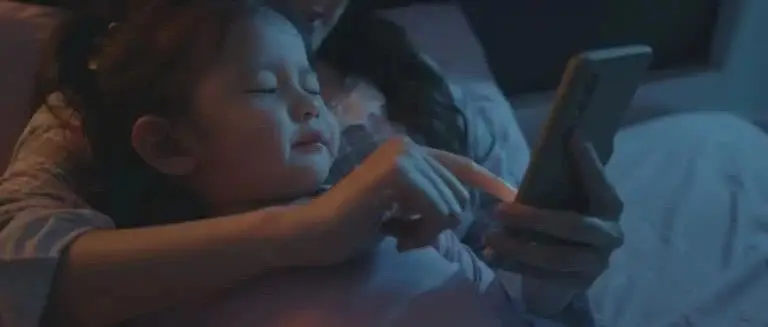
When you finally finish a day’s work, tidy up the house, and put the kids to bed, it’s time for some “Me Time”. Playing with my phone before bed is a great reward for the day.
Even if there’s nothing I really want to watch, I just can’t stop scrolling through my phone. Don’t ask, it feels like going to sleep now would be “too much of a loss.” This is the only time of the day that truly belongs to me; how could I bear to sleep?
But how damaging is it to play with your phone in the dark? Can sitting and playing with the light on reduce this damage? Let’s talk about it today.
What are the dangers of using your phone in the dark?
1. It can exacerbate intermittent exotropia
When you look at your phone at night, do you often find yourself more accustomed to looking at your phone with one eye, while the other eye is closed or blocked by a pillow? This is a very typical symptom of intermittent exotropia.
Many people would say, “No, I’m just used to it,” or “I’m just a bit lazy to open both eyes to look.” NoNoNo, friends with this condition can try to really open both eyes and see if there is double vision (diplopia) or difficulty focusing clearly.
Intermittent exotropia is the most common type of strabismus, accounting for more than 40% of exotropia cases. Patients with intermittent exotropia can control the proper alignment of their eyes through binocular fusion, which makes them appear normal. However, when concentration is lost or binocular fusion is disrupted, a manifest exotropia occurs, which is the intermittent appearance of proper alignment and exotropia , hence the term intermittent exotropia.
Clinically, children who prefer to close one eye in bright sunlight are also one of the typical symptoms.
Caption: Top: Normal; Bottom: Exotropia
Myopic eyes use less accommodation without glasses, and the accommodative convergence decreases accordingly. The strong light stimulation in the dark further disrupts the binocular fusion ability , making those with intermittent exotropia more prone to double vision.
Blocking one eye may temporarily solve the double vision problem, but over time, it becomes more difficult for the two eyes to work well together, and the brain’s control over strabismus will gradually weaken, which may exacerbate the condition of strabismus.
2. It increases the risk of glaucoma attacks
Watching your phone in the dark can trigger glaucoma attacks in people who have the corresponding anatomical basis.
In a dark environment, the pupil dilates, and the iris muscles around the pupil bulge outward. If there is an anatomical structure abnormality, such as a shallow anterior chamber depth, the bulging iris tissue will obstruct the circulation of aqueous humor in the anterior and posterior chambers of the eye , leading to increased internal ocular pressure, and subsequently trigger acute angle-closure glaucoma.
Caption: Left: Normal angle; Right: Angle closure
High-risk groups include:the elderly, those with a family history of glaucoma, and patients with high myopia.
Therefore, if there are high-risk groups for glaucoma in your family, special attention is needed. Glaucoma attacks may be accompanied by severe eye pain, headache, and irreversible vision damage.
3. Increase in anisometropia
You can imagine the distance when you are lying in bed playing with your phone, most people are at an ultra-close distance of only ten to twenty centimeters from their eyes. The regulatory burden on the ciliary muscle is very heavy.
At the same time, glare is also easy to produce under strong light and dark contrast, which further increases visual fatigue, and the lying position is also easy to cause uneven refractive power in both eyes, leading to anisometropia.
Caption: Anisometropia, i.e., a large difference in refractive power between the two eyes.
In addition, another major hazard of playing with your phone before bed is that it makes people more and more spirited. Blue light suppresses the secretion of melatonin, making the brain think it is still daytime, leading to difficulty falling asleep. Even after falling asleep, it is not easy to enter deep sleep, which seriously affects sleep quality.
Can sitting and playing with the light on completely offset the damage?
Adjusting posture, myopic people trying to wear glasses, sitting up with the light on, or avoiding uneven states of both eyes as much as possible are all ways to avoid the above problems, but whether playing with the light on or off, the following problems are inevitably easy to appear.
1. Dry eye syndrome
When we focus on the small screen in front of us, it is aptly described as “unblinking.”
Studies have confirmed that the frequency of blinking decreases significantly when using electronic screens such as laptops, tablets, e-readers, and smartphones, especially when using smartphones, the decrease in blinking frequency is the most obvious. It can drop from about 16 times per minute in daily conversation to about 6 times per minute.
Our eyes continuously secrete tears and drain excess tears through the nasal cavity. Although we usually don’t feel the secretion of tears, each blink helps us refresh the tear film on the surface of our eyes. At the same time, the slight pressure when blinking also allows the meibomian glands in the upper and lower eyelids, which are responsible for oil secretion, to release an appropriate amount of meibomian esters. The meibomian esters, along with tears, are applied to the surface of the eyes, playing a role in moisturizing.
Caption: Left image: Normal eyes; Right image: Dry eye syndrome
When the frequency of blinking decreases significantly, the tear film breaks down more quickly, and a large amount of tears evaporate from the surface of the eyes, which can easily lead todry, sour, foreign body sensation, or even irritable tearing.
I have really encountered friends who say they are definitely not dry-eyed because they often suddenly feel stinging and shed a lot of tears when looking at their phones at night. I just quietly asked, “So even with this, you can’t put the phone down?” “Yes, I grit my teeth and keep scrolling.”
2. Increase the risk of acute comitant esotropia
Acute comitant esotropia, also known as acute acquired comitant esotropia (acute acquired concomitant esotropia, AACE) , is a rare type of comitant esotropia that can occur in both children and adults. The clinical characteristic is sudden large-angle esotropia accompanied by double vision, which seriously affects vision and quality of life.
The etiology of AACE is not yet fully understood. Previous studies have shown that uncorrected refractive errors(later studies found that AACE can occur regardless of whether myopia is corrected), long-term near work, and convergence spasm may lead to the progression of AACE , and some intracranial diseases may also present with AACE as the initial symptom.
And “long-term near work” has become the main cause of AACE in recent years. Especially after COVID-19, the popularity of working from home and online teaching has greatly increased the time spent on near work, and the incidence of AACE has also increased significantly.
In a 2025 clinical observation of 61 patients with AACE, 18 could clearly recall their eye habits before the onset of the disease, most of whom mentioned long-term near work in the medical questionnaire, and both the sitting distance and pen-holding distance were below the normal range.
So whether it’s adults busy with work (or playing with phones) or students busy with studying (or playing with phones), it is essential to arrange intermittent rest time for your eyes.
3. Promote the continuous progression of myopia
In the past, we always thought that once we reached 18 years old and became adults, our myopia would stabilize and not change.
But the reality is cruel. Due to the poor eye habits brought about by modern civilization, a considerable number of adults continue to have increasing myopia , especially for job types with high near work demands, such as financial workers, text workers, programmers, etc., and those with poor eye habits, such as workers who play with their phones in the dark until the middle of the night.
In recent years, I have found that many women have a significant increase in myopia after childbirth. Possible related factors are on the one hand, hormonal changes during pregnancy and after childbirth, and on the other hand, mothers have a lot of scenes of using mobile phones at night while taking care of babies. Because they are afraid that the light will affect the child, they can only use their phones in the dark.
So, in a word, the real reliable eye protection habit is never playing with your phone with the light on, but 👇:
The less overall eye use, the better! 👀
You can try changing your pre-sleep activity to listening to music or podcasts 🎵
Use your ears instead of your eyes and have a good rest 😴.
Disclaimer: The purpose of the article is to provide general health information. For personal medical issues, please consult a doctor. To reprint the article, please contact: medicine@distinctclinic.com.